
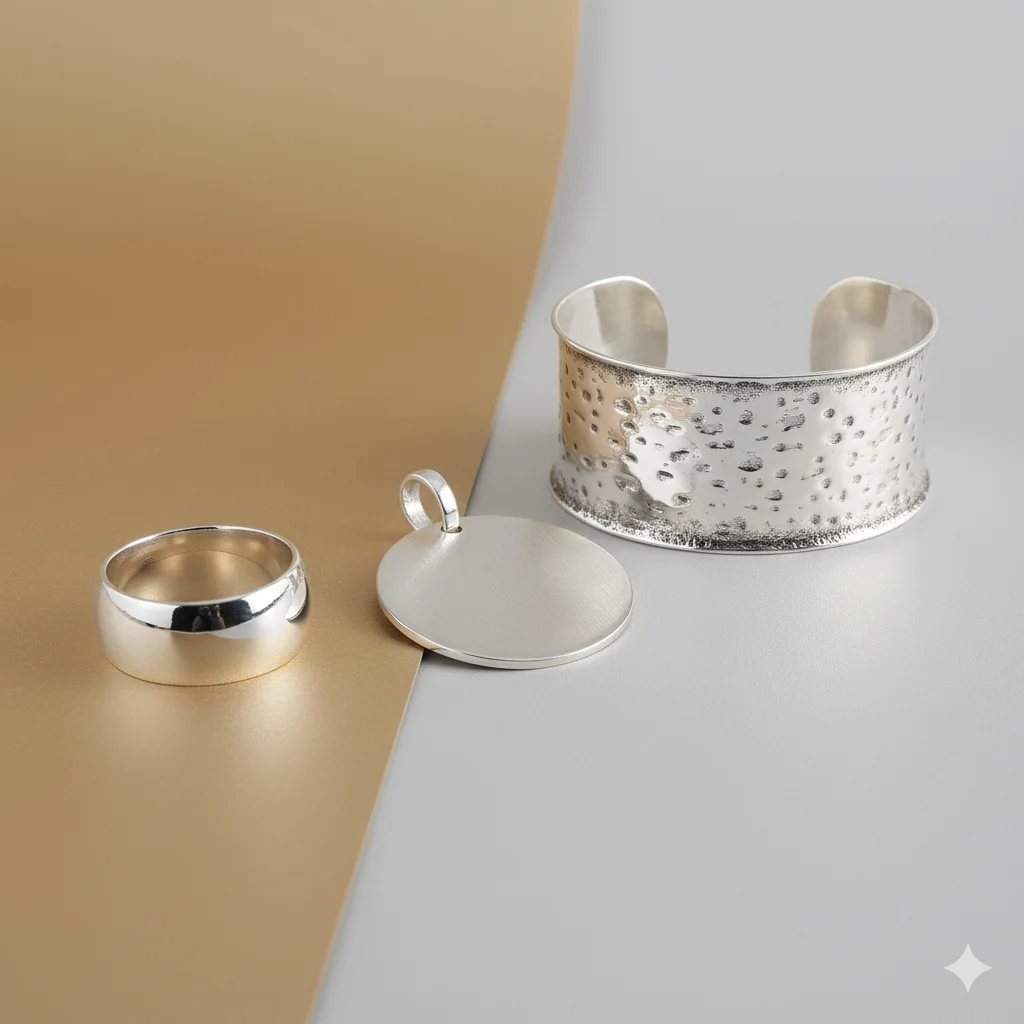
A jewellery finish is more than an aesthetic choice. It changes how light reflects, how the surface feels and even the personality of a piece.
On silver jewellery, a perfectly polished surface tells a different story from a brushed or hammered finish. Each technique transforms the metal and gives it a distinct character.
At Wateke, we particularly appreciate how the same material can change rhythm simply through the way its surface is worked. Here is how to recognise the main silver jewellery finishes and understand what makes each one distinctive.
Polished finish: light and shine
A polished finish is probably the most familiar. The metal is worked until the surface becomes very smooth and strongly reflects light. On silver, the result can appear almost mirror-like.
This finish gives jewellery a bright, clean and elegant appearance and highlights simple forms and flowing lines. A polished pendant can change at the slightest movement as light moves across its surface.
It is ideal for people who enjoy luminous, graphic jewellery. Small signs of wear may be more visible on a highly polished surface, but over time they can simply become part of the piece’s story.
Brushed finish: softness and character
A brushed finish is more matt. Fine, regular lines are created on the metal, reducing direct reflections and giving the piece a softer, contemporary appearance.
On recycled silver, this finish can add depth. Rather than reflecting everything around it, the surface absorbs more light and reveals its texture when viewed closely.
It works particularly well with minimalist, geometric and nature-inspired designs and attracts attention without being overly bright.
Hammered finish: no two surfaces are exactly alike
A hammered finish is created by working the metal with small, controlled impacts. Each mark changes the way light reflects, producing a lively, irregular surface full of movement.
Depending on the size and depth of the marks, the effect can be subtle or expressive. Some pieces show almost imperceptible variations, while others use texture as the central design element.
This irregularity is part of its appeal. A hammered surface can evoke moving water, the vibration of an instrument or the marks left by an artisan’s gesture. It shows that the metal was not merely transformed; it was worked.
One finish can completely transform the same design
Imagine three pendants with exactly the same shape. The polished one looks bright and graphic. The brushed one feels softer, calmer and more contemporary. The hammered one appears more organic and expressive.
The silhouette is identical, yet the perception changes. This is why finish is so important: it changes the character of a form without changing the form itself. The surface becomes an integral part of the design.
When craftsmanship remains visible
Some finishes preserve traces of the making process. In a world where many objects are made to look exactly alike, a slight variation can remind us that a person worked on the piece.
A small difference in texture or reflection is not necessarily an imperfection. It may be the natural result of craftsmanship. At Wateke, we value jewellery that retains this human dimension rather than seeking industrial uniformity.
Which finish should you choose?
There is no single best finish. The right choice depends on your style and how you want to wear the piece.
Choose a polished finish if you enjoy light and crisp surfaces, a brushed finish for a softer contemporary look, or a hammered finish for more texture and character.
Several finishes can also be combined on one piece. A polished area beside a matt surface can create a subtle contrast that reveals details in the design.
The surface evolves with you
Jewellery worn regularly changes slightly over time. Fine marks may appear, the surface may soften and reflections may evolve. This transformation is part of the life of the piece.
Silver can be cleaned and cared for, but a piece does not have to remain exactly as it was on the first day to retain its beauty. At Wateke, we like to think that jewellery moves and evolves with the person who wears it.